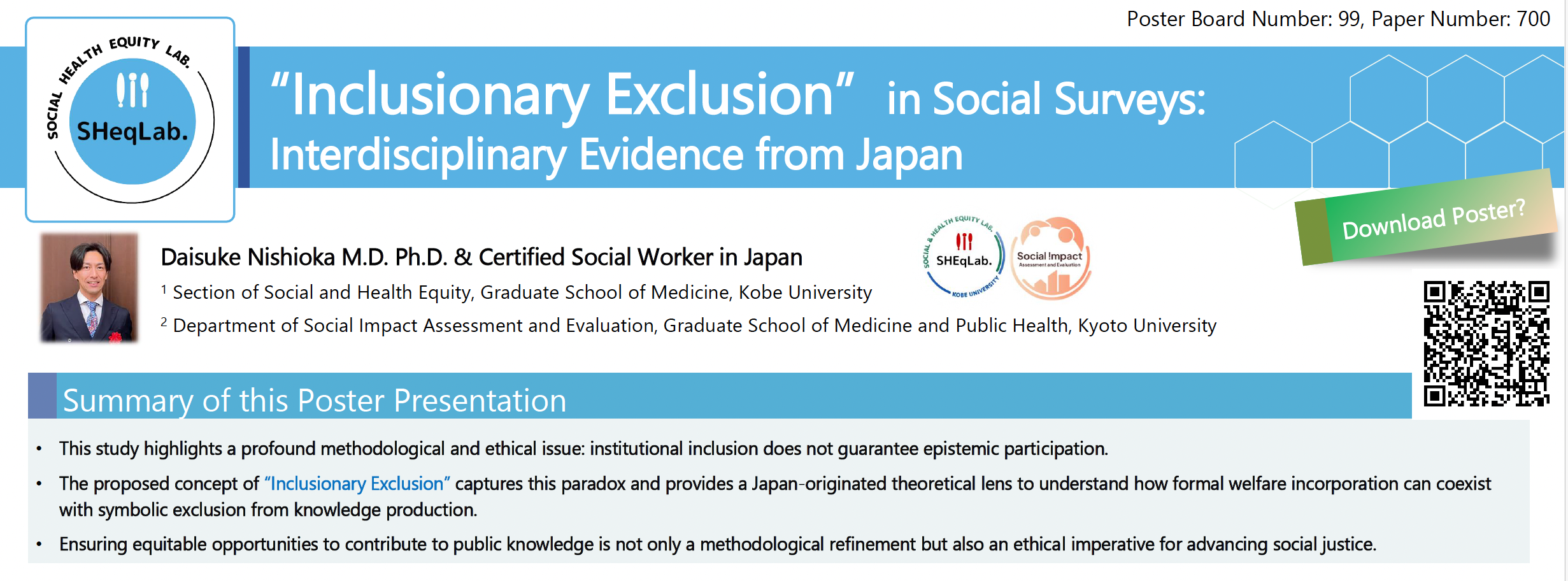
スコットランドのAberdeenで開催された、15th European Conference on Social Work Research (ECSWR 2026)で発表しました。
Aberdeenに辿り着くまでは、話しきれないほどいろいろあって人生で一番ストレスフルだったかもしれませんが、無事に参加し、発表してくることができました。
多くの方にご覧いただき、ご質問いただくだけでなく、共感をいただくことができました。Data Justiceに関心のある人も他におり、議論が盛り上がりました。”Include”しているが、”Exclude”している。このパラドックスはヨーロッパのソーシャルワーク研究の学会でも合意していただける内容で、研究の国際性や自分自身の研究の射程がヨーロッパのソーシャルワーク研究の範囲内にあることも確認することができました。
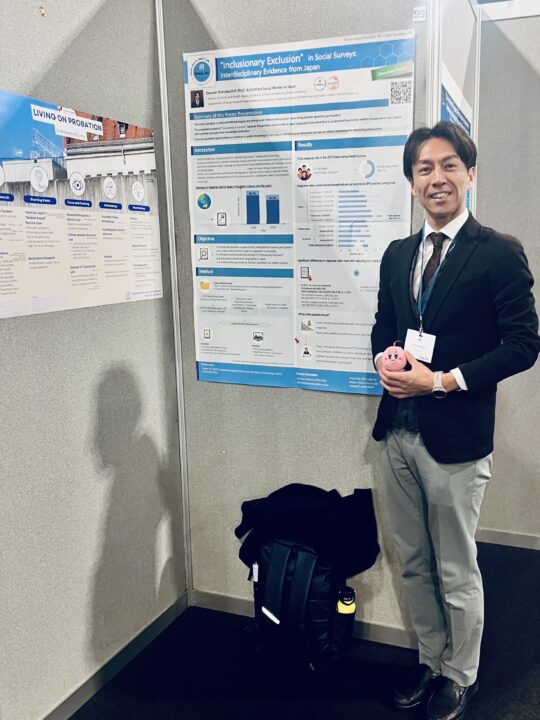
今後も一緒に研究できる関係が芽生えそうです!
素敵なセミナーは、海外に目を向けるとたくさんあるんだなぁと話を聞いて実感しました。
西岡 大輔(にしおか だいすけ)
抄録の一部はこちらから↓
Title
Inclusionary Exclusion” in Social Surveys: Interdisciplinary Evidence from Japan
Background and purpose
Social surveys are indispensable for identifying citizens’ needs and informing evidence-based social policies. However, many countries have experienced a persistent decline in response rates—raising concerns about representativeness and whose voices are being heard. While prior studies have examined demographic factors such as age or gender, there remains limited understanding of how socioeconomic conditions affect participation in surveys.
This study introduces the concept of “Inclusionary Exclusion”, which refers to the paradoxical situation in which individuals who are formally included in welfare institutions remain symbolically excluded from the sphere of public knowledge production. Although they are beneficiaries of institutional inclusion, their voices are effectively silenced in collective data-gathering processes. This concept extends Fricker’s (2007) framework of epistemic injustice by emphasizing the tension between institutional incorporation and epistemic invisibility.
The objective of this study was twofold: first, to empirically examine socioeconomic inequalities in survey participation using linked administrative data in a Japanese municipality; second, to introduce and illustrate the concept of Inclusionary Exclusion as a theoretical contribution originating in Japan—a context often perceived as fairness-oriented in its welfare system.